Please feel free to add your comments and share your stories about Piatt Castles. Whether you visited when you were a child, gave tours when you were in high school, were married on the grounds, or had any other experience here we'd love to hear how Piatt Castles has played a role in your life. All of your stories together make up our story.

Sunday, June 3, 2012

Poetry

The way I see it, poetry is a method of applying beauty to the mundane.  It elevates the ordinary.  While I am most certainly not a poet (my version of creating beauty around the ordinary involves the formatting of complicated data into easily understood spreadsheets and databases), but many Piatts over the years have written poetry.  I was reminded of this when, last weekend, a family of Piatt descendants visited the Castles.  While touring the homes with her parents, twelve-year-old Zoe was inspired to write the following poems:


Exhibit Panel, Mac-A-Cheek
My vernon of poetry

Two Minutes of Tinkering

1.     
  
I wish I’d known her,
You can tell,
She and I would’ve gotten
Along quite well.
I love to write and she did too
Oh Sarah, why couldn’t I have known you?

2.       

The Piatts, at least they seemed
Like nice folks, plain as can be
And though they now they are dead,
And they are in my family tree,
Their blood still runs in me.

I, Zoe, will carry on,
Writing books, pomes and songs
And all the time I’m doing so
Sarah’s sprit in me shall not go.

The "her" to whom Zoe is referring is Sarah Piatt, the most prolific of the Piatt poets.  I'm a bit embarrassed to say that I'm not actually sure I'v read any of her poetry.  I need to take care of that.  However, Zoe's poems bring up the fascinating issue of continuation.  

When I look back at the four generations before me who gave tours at Mac-A-Cheek and the six generations before me who lived on the land that my family still calls home it is hard not be taken with the ways in which the work of one generation is continued on and how the values and ideologies that informed one generation still inform my mother and I.  
The dissemination of information has been important to Piatts for generations.  This took many forms, but always comes down to the love of sharing knowledge and ideas that is prevalent in every generation of Piatts.  Abram Piatt wrote and published a newspaper called the Mac-A-Cheek Press.  William McCoy displayed his collection of curiosities to the public.  Sarah Piatt and many other wrote poems and plays.  Donn Piatt was a prolific writer in many genres.  My grandfather, William, was well known for his "gift of gab" and his thrill at telling stories to anyone who would listed.  As I sit at my end of this long line of information spreaders, the last line of Zoe's second poem rings particularly true.  It's not just Sarah's spirit that lives in me, but the collective spirits of all who have come before me and who's work I continue as I use the technology of my time and the particular skills available to me to elevate and disseminate various forms of information through spread shed analysis, exhibit design, and of course this blog.  

What does your family value?  How do you embody and apply those values?  I think it's fascinating to look at the ways in which our activities change as the decades go by but the inspiration for and the function of the activities continues.

Saturday, May 26, 2012

Toys

I was talking to my mother the other day about topics that might make good blog posts.  She told me that some Piatt was born the year the Hula Hoop was invented.  I was apparently only half listening, because I now have no idea whom she was talking about.  I thought perhaps I would look up the year of the hoop's birth and figure out which Piatt she was referencing, but I learned that the hula hoop was conceptually invented by the Greeks in the 5th Century.  No Piatt was born then, so far as I know.  The modern hula hoop was branded as such by Wham-O toys in 1957.  No Piatts born then either.  Perhaps I mis-heard the entire conversation.  Regardless, it did get me thinking about toys.  If the same toy can be popular in 5th Century Greece and 20th Century America, there may well be something universal about the ways we play and what we find entertaining.  Children and adults alike are fascinated by they toys of yester-year.  

Hula Hoop, ca 1960
By now we all know that Mac-A-Cheek was opened for tours in 1912, but of course that is not the entire story.  William McCoy Piatt opened his drawing room in order to display his cabinet of curiosities, but the rest of the house remained a private residence.  Over the years more and more of the home was opened for tours.  When my mother was a child in the 1950s and '60s the family of five lived primarily in a small apartment in the back of the house (their bedrooms are now offices, and their kitchen is now the gift shop), but they kept a family living room and business office in an area that is now open for tours.  My step-father and I call this room the Star Room because of the large star in the parquet floor, but this room and the adjacent dining room were the last part of the house to be included on the tour.  Much as the drawing room is furnished as it was when William McCoy first displayed his curiosity cabinet, the back part of the house contains artifacts from the lives of the last Piatts to live at Mac-A-Cheek.  This is by far one of the most popular rooms, and I think this is so for two reasons.  First, visitors are given the opportunity to explore their own history and to share that history with their families.  The middle of the 20th Century is still very much part of our current story, and there is something very compelling about the familiar presented within the museum context.  Second, the whimsy of toys is irresistible.  Whether they are toys we remember from our youth or toys that far predate our childhoods, there is something so charming about them that we can't help but smile.

Below are a few pictures of my favorite toys on exhibit in Mac-A-Cheek.  Enjoy!

Winky Dink:  the first interactive television game

Barbie, 1961
Barbie, 1961


Tuesday, May 15, 2012

Commuting

Abram Piatt in front of Mac-A-Cheek
I'm thinking about commuting.  Before the castles were built, Judge Benjamin Piatt raised his family (including sons Abram and Donn who would go on to build Mac-A-Cheek and Mac-O-Chee, respectively) in a small wood-frame home near where Mac-A-Cheek now stands.  Some of you may remember when a remodeled version of this home housed a gift shop, but that's beside the point.  Benjamin was a Judge on the Circuit Court and he frequently had to travel to court houses around his district and often had business in Cincinnati, where he lived before moving to West Liberty.  It is just over 100 miles from Cincinnati to West Liberty, and Benjamin made this trip frequently.  This sounds like a pain until we remember that it was the middle of the 19th Century, and Benjamin was making this trip on a horse.  It took three days.
By comparison, Benjamin's son Abram lived and worked on the land in Logan County he had inherited from his father.  Aside from his military service he had little reason to venture farther than he could see.  Later in his life he frequently visited his brother Donn at his home, one mile down the road.  

Commuting is on my mind because I will spend the next three months commuting 50 miles each way (it would be 30 miles if there weren't a pesky bay in the way) from a small town in New Jersey to Manhattan.  I am very pleased that (a) I don't have to make this trip on horse-back, and (b) the NJ Transit trains have quiet commuter cars.  I will have lots of time for reading (and writing blog posts), and it won't take me an entire day each way.  I am a little jealous of Abram and his tiny commute, but I'm also so grateful that modern transportation allows me to take advantage of professional opportunities without the hassle of horseshoes.

NJ Transit Train

Saturday, May 5, 2012

Renewal & Reflection

Detail from Oliver Frey's 1881 fresco in the ceiling
of Mac-A-Cheek.  Many of the flowers portrayed here
were also planted in the garden in front of the home.
Spring is a time of renewal, and birthdays are times for reflection.  This spring I am completing the first year of my Master's Degree, and at the Castles we are celebrating our 100th birthday.  The last days of spring semester are an amazing time on campus.  The overwhelming stress of a heavy work load starts to lift, and it is replaced by anxiety about exams and excitement about the summer.  As we watch our colleagues prepare for graduation we're reminded how fleeting our time in academia is.  Very soon we will transition back into the 'real world,' and however smooth or trying that transition may be it will give us the opportunity to reflect on what we have learned and what we hope to accomplish going forward.
At Piatt Castles we are approaching our anniversary not just as a time for celebration but also as a period for reflection and planning.  We are using the entire year to review and redevelop the content of our exhibits and to reflect on what we hope to accomplish as a cultural institution.
In 1912 the simple goal of displaying a cabinet of curiosities was simple to accomplish with straightforward methods for evaluating sucess.  Today the goals and success metrics are much more complex, and we are using our 100th year of tours to take a step back and analyze the experience we provide to our visitors in order determine our goals for visitor interaction and find new and informative ways to measure how well we are meeting our goals.  You can help us by telling us what you took away from your visit to Piatt Castles.  What was your most memorable experience?  If you had to describe the museum to a friend, how would you do it?

Saturday, April 21, 2012

Why would you bring strangers into your house?

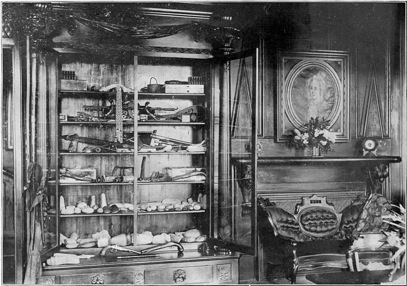
William McCoy Piatt's Cabinet of Curiousities, 2012
We know that William McCoy Piatt opened Mac-A-Cheek to the public by 1912.  We don't know exactly why.  One popular theory is that he was so tired of people coming up to the house and asking for a tour that he decided to start charging admission to keep them away.  Although it seems plausible that strangers would come to the door asking to be shown around (it is a very cool building after all), but as compelling as this idea may be it is not likely the real story.
William McCoy Piatt's Cabinet of Curiosities, ca. 1915
If you've visited Mac-A-Cheek, you probably remember the large cabinet in the drawing room full of all sorts of random objects (including an ear of corn, a tooth from a mastodon and assorted hatchets).  Many, though not all, of these objects were in this cabinet when William McCoy first opened Mac-A-Cheek.  Curiosity Cabinets such as this were popular as far back as the Renaissance.  They piqued the interest of viewers and allowed them to explore unique and unexpected items.  William McCoy had spent much of his life collecting strange and interesting things that he found around the farm.  He had a cabinet custom-built and installed in his drawing room in order to display this collection, and his desire to share the collection with others is likely the true reason that Mac-A-Cheek was first opened to the public.

Sunday, April 15, 2012

Why not make it a bed and breakfast?

Fresco at Mac-O-Chee
I can't begin to count the number of times I've been told that we should turn castles Mac-A-Cheek and Mac-O-Chee into a pair of bed and breakfasts.  Aside from the minor issues of indoor plumbing (or the lack thereof) and very minimal electricity, it seems like a pretty good idea on face value.  I don't really want to spend the rest of my life making coffee and muffins, but I'm sure I could find someone who does. And, yes, providing accommodations for romantic getaways would almost certainly generate more revenue than cultural tourism.
As we enter our 100th year of giving tours it is inevitable that we take a step back and wonder why on earth we are doing this at all.  You have to admit that it's a pretty peculiar situation.  Many family businesses last for only a couple of generations, and those that do last quickly move the place of business out of the living room.  Not us!  I'm the 5th generation Piatt to give tours at the Castles, and rather than move the business out of the living room, we relinquished the living room for the sake of the business.  I can't say exactly why William McCoy decided to open the doors in 1912, but I can reflect on why we keep them open now.  The story we have to tell is both incredibly unique and wonderfully universal.  It is the story of an American family fighting a series of wars and surviving the great depression, and it is also a story of diplomats and poets, soldiers and salesmen, judges and farmers.  Piatt Castles provides an escape from the contemporary into a past that is both familiar and intriguing.  It allows for exploration and contemplation, and it gives us the chance to give back to our community through arts and cultural programming what we could never give back through muffins and coffee.

Thursday, April 5, 2012

Multi-tasking

It seems to be a commonly held belief that technological advancements over the past decades have encouraged us to do more with our limited time. For example, I'm writing this post on my phone in the 10 minutes before a class.
Regardless of the technology of the day, multi-tasking has always been a major part of life at Piatt Castles. I work on the website and design t-shirts in between the classes I'm taking toward my Master's degree. My mother, Margaret runs the Theatre department at Urbana University while running the programming and operations at the Castles. My Grandmother taught high school while working at the Castles. My Grandfather's aunts Bertie and Marguerite ran a farm and the Castle while raising their young nephews and bringing the family through the Great Depression.
Like most families Piatts have a wide range of interests, and the aggregation of those interests and the multiple careers that have supplemented work at Piatt Castles over the past several generations make the stories we tell particularly interesting. I feel that every topic is best examined from a wide variety of perspectives, and at the Castles we look at the history of the buildings through the eyes of parents, children, educators, students, farmers, soldiers, business people, visitors, and more. You can help us to examine these stories by adding your own unique perspective.